Teaching
Teaching, to me, is mostly about passion — and about getting people to build things they did not think they could build. I keep classic lecture time to a minimum and replace it with active, hands-on, project- and challenge-based learning: real problems, hardware on the desk, and a lot of room to explore.
I teach at HSBI, Campus Gütersloh, in the area of Distributed and Edge Computing, and I bring the same material to academic and corporate workshops. All course material is open and lives in version control rather than in a static archive.
How I teach
- Project- and challenge-based (PBL/CBE). Students start from a story or a real-world challenge and work toward a working solution. There is no strict split between lecture and lab — students experiment with hardware, programming, and networking from the start, bridging the virtual and physical worlds through prototyping.
- Active learning. Flipped classrooms, peer review, storytelling, design thinking, jigsaw, and interactive master classes. What others call failure I prefer to call exploration — ideas that do not pan out are learning outcomes too.
- Assessment as feedback. A mix of formative and summative assessment: project evaluations, portfolios, peer review, and self-assessment, with constructive feedback and a growth mindset.
- Inclusion. Different perspectives make a class better: accessibility, programs for women in STEM, and including students and stakeholders from Africa, Central and South Asia, and South America.
Courses & workbooks
The material lives in the open and is updated as classes evolve. The main entry points are:
IoTempower
The framework we teach with — source on GitHub (website: iotempower.us).
iotempire-teaching
Full workbooks and workshops — the living home of all my course material.
Video playlist
The curated IoTempower teaching playlist — best watched alongside the course material.
Recordings also live on my YouTube channel @ulnonet and on the University of Tartu teaching channel @ut-teaching-ulno.
Currently available workbooks (all in iotempire-teaching):
- University of Tartu IoT Introduction (15–16 weeks) — a modular, semester-long deep dive, from introduction to final projects.
- HSBI/GT Microcontroller Programming — 4-day block and 10-day extended editions: basic electronics through multi-node final projects, local-first.
- HSBI/GT Networking and IoT Solutions (10 weeks) — TCP/IP and OpenWrt edge gateways, mesh and overlay networks, MQTT, ESP-NOW, industrial bridging, and IoTempower fleet management.
- HSBI/GT Sensors and Actuators (10 days) — measurement technique, I²C, sensor characterization and calibration, LEDs, motors, and sensor/actuator systems.
- HSBI/GT Databases (11 sessions) — a local-first redesign: schema audits, code-first data contracts, LLM-assisted SQL with profiling, integrity constraints, and polyglot embedded persistence.
- Workshops — Mastering IoT Solutions (2–3 h master class) and Magic Wands (4–16 h, edge & voice computing).
The IoT course (the IoTempower way)
Wherever I have landed, I have taught IoT — and others now teach with the same material. The course bridges the virtual and the physical: challenge-based, hands-on, and built entirely on open source (IoTempower plus Node-RED), so it is affordable and easy to replicate. We bring the framework in early for quick wins; after covering the core tools, students design and build a final project that starts from a story about a real-world problem.
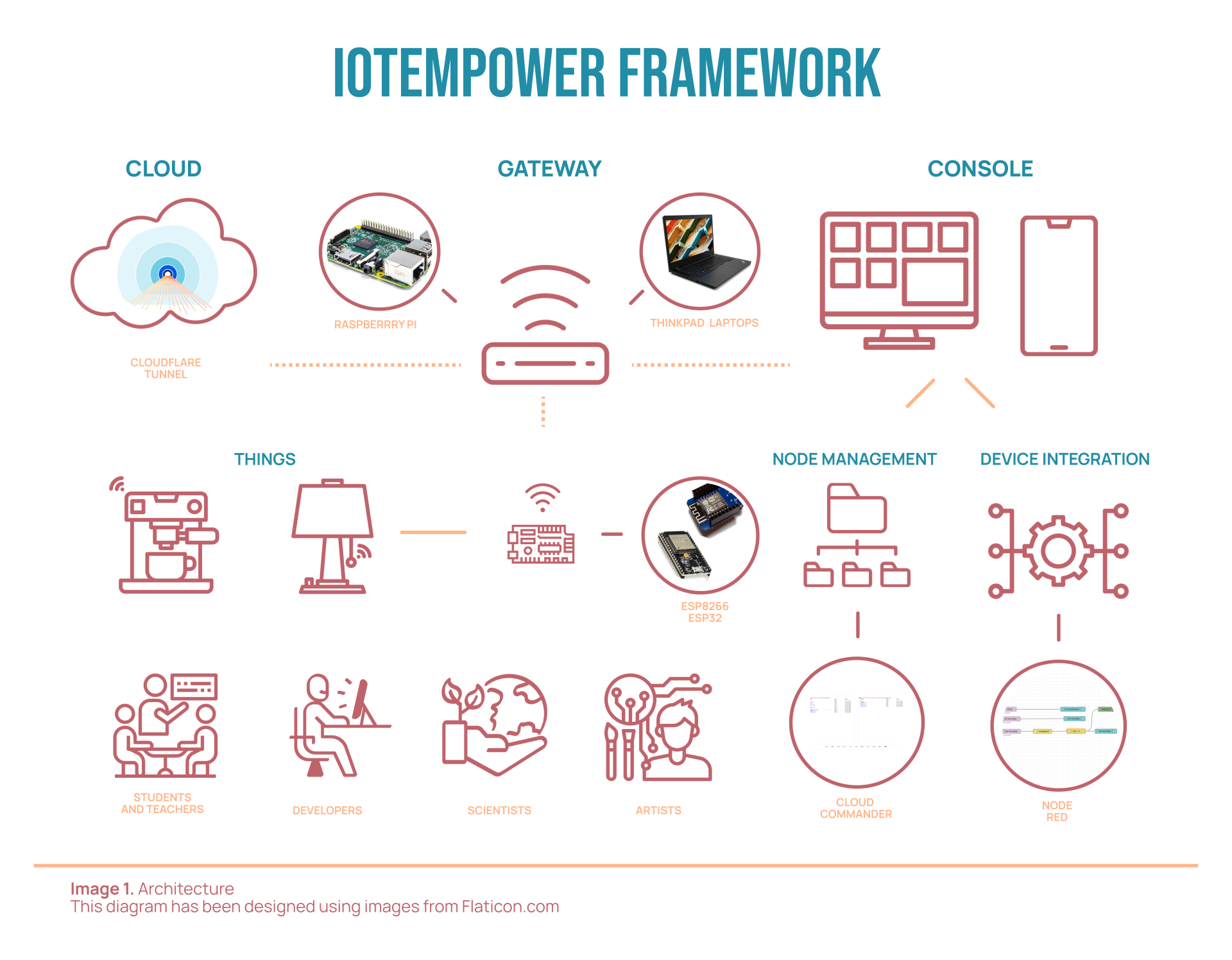
Course elements: storytelling and story-driven development, basic electronics, networking and communication protocols, IoT architecture, and open-stack integration with Node-RED — all under the IoTempower umbrella.
Learning tools & the kit
- A chat (Discord) where students across Tartu, Linz, Regensburg, and beyond learn from each other.
- Slides, tasks, and videos — see the repo and playlist above.
- A kit per team (sensors, actuators, cables, power, a gateway, microcontrollers), chosen for affordability and easy sourcing, so each team controls its own network with no cloud or university dependency.
- LLMs (ChatGPT, Copilot, Gemini) used deliberately as in-class research tools — and as material for critical reflection.
What I teach
- Internet of Things — home and building automation, IoT security, foundations of IoT, and mobile + cloud integration.
- Distributed & embedded systems — microcontroller programming, networking protocols, and edge gateways.
- Edge & Cloud Computing — distributed systems, virtualization, and containerization.
- Databases — from an introduction to modern, local-first persistence.
- Programming & Software Engineering — Python, Java, C/C++, modelling, agile development, and DevOps with CI/CD.
- Extended Reality (XR) — VR/AR work environments and teleoperation.
Future additions I would enjoy teaching: Operating Systems, Cybersecurity, DevOps/Continuous Integration & Deployment, and Extended Reality.
Supervision
Heads-up: my thesis supervision pages are soon to be archived. They reflect my years at the University of Tartu; new supervision opportunities at HSBI will be announced separately.
Over the years I have supervised five PhD students, two ongoing PhD projects (Eduardo Brito and Renato Perotto Machado at the University of Tartu), and more than 30 master and more than 30 bachelor theses. If you are an HSBI student with a good idea, the best route is still to get in touch.
References
- Machado, Norbisrath, Jubeh: IoT Educational Framework Case Study: Devices as Things for Hands-on Collaboration, Journal of Engineering Education Transformations (2024).
- IoT Dev Kits — the hardware of the kit.
- Teaching material: Google Drive · videos.ulno.net · Discord.
Stories from the classroom
A few examples of what students build with this approach:
- Story of an International Master Student and the HarvestMate Smart Planter
- Story of an Austrian Bachelor Student and the Smart Nursing Home
- Story of a University Professor and Teaching IoT the IoTempower Way
Older course pages — the IoT introduction, the immersion class, and the makers-and-doers class — are kept for reference, alongside the legacy IoT classes and the archive.